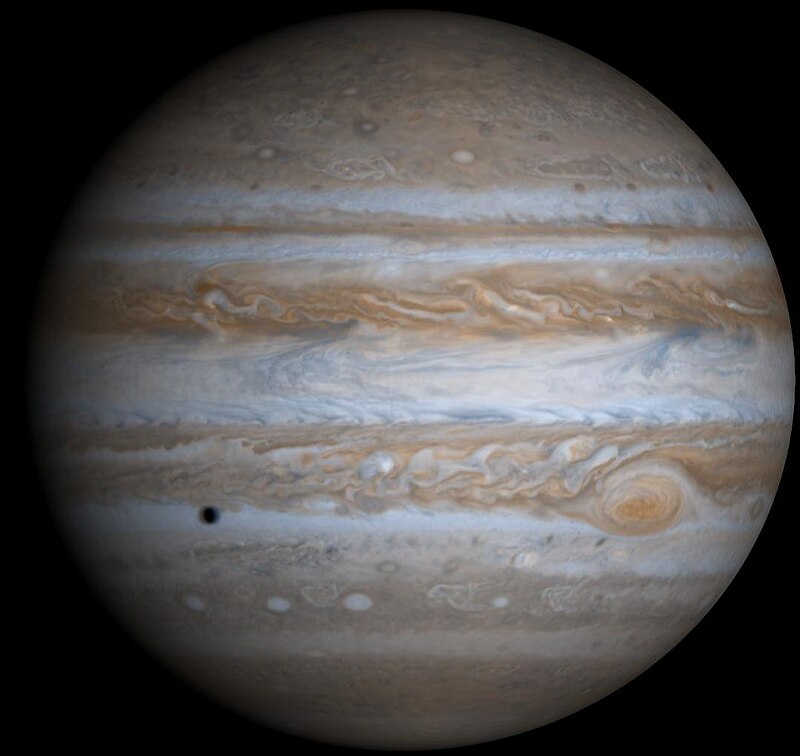
Jupiter
Jupiter is the largest planet
in the solar system. It is called Jupiter because it is persistent in its path,
i.e. it persists, continues, and strives in it without slackening or breaking.
Jupiter appears from Earth with great brightness,
reaching an apparent magnitude of (−2.94), which makes it the third brightest
object in the night sky after the Moon and Venus.
Jupiter is the fifth planet from the Sun and the
largest planet in the solar system.
It is a gas giant and its mass is slightly less than
1/1000 of the mass of the Sun, but it is equal to two-thirds of the total mass
of the rest of the planets in the system.
The classification of gas giants includes Saturn,
Uranus, and Neptune in addition to Jupiter.
These four planets are called the Jovian planets.
Several astronomical missions were sent to explore
Jupiter, most of them during the beginning of the Pioneer and Voyager programs
and later by the Galileo orbiter.
The last spacecraft to fly by Jupiter was New Horizons
in 2007.
This probe used Jupiter's gravity to accelerate it on
its journey to Pluto, until Juno was able to reach Jupiter's orbit in 2016.
Future missions to Jupiter and the Jovian planets aim to explore the possibility
of a liquid ocean beneath the ice cap of Europa, one of Jupiter's moons.