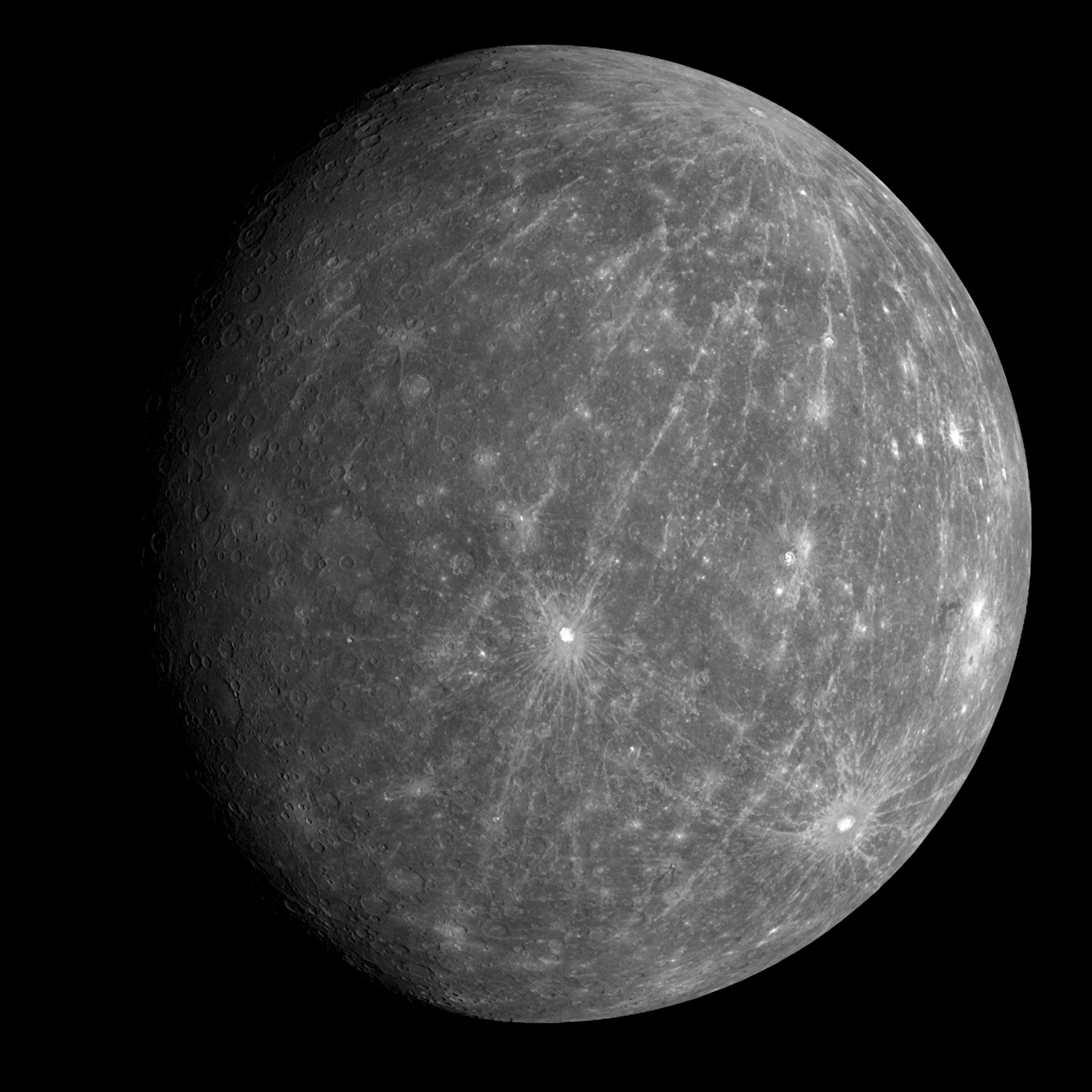
Mercury
Mercury is the smallest of the
eight planets in the solar system.
Scientists were late in discovering Mercury because of
its location, as it is close to the western horizon, and therefore the
atmosphere absorbs the light emitted by it, in addition to the fact that the
twilight that appears at sunset contributes to hiding it, which makes it
difficult to observe, but it is noteworthy that the first information obtained
by astronomers about this planet was in 1974-1975, when the American Mariner
spacecraft headed to its surface to study it.
The distance between Mercury and the sun is about 47.6
km, and therefore it is considered the closest planet in the solar system to the
sun.
The sidereal day of Mercury is estimated at 58.65
Earth days, while its sidereal year is equal to 87.97 Earth days, which means
that one day on this planet is equal to a third of a year.
The gravity on this planet is equal to 0.378 Earth's
gravity.
At first glance, the surface of Mercury appears
similar to the crater-filled terrain of the moon. But Mercury is much denser,
and yet the planet has a metal core that occupies about 61% of its volume. In
addition, its surface shows significant differences from lunar terrain,
including the absence of the massive, dark lava flows and the presence of
buckles and bumps that indicate that Mercury is shrinking. Mercury has no known
moons.