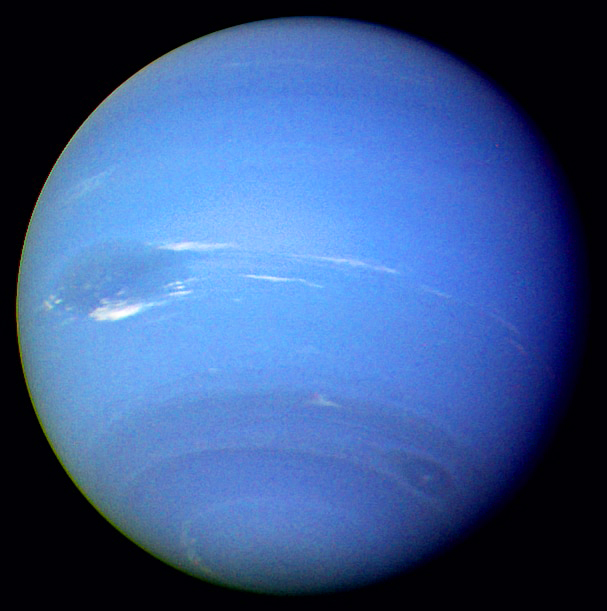
Neptune
Neptune means the god of water in Greek, and it is
called the blue planet. It is one of the planets of the solar system and the
fourth largest of the eight planets. It is the eighth planet in the solar system
and the farthest from the sun in the solar system. It is the fourth largest
planet in relation to its diameter and the third largest planet in relation to
its mass.
Neptune's mass is 17 times the mass of Earth.
It is slightly larger than its close twin Uranus,
which is 15 times the mass of Earth.
Neptune completes one orbit around the sun every
(164.8) years at an average distance of about 30.1 astronomical units (4.5
billion km).
Neptune was named after the god of water and the sea
in Roman mythology (Neptune) where it was discovered on September 23, 1846.
Neptune is invisible to the naked eye and Neptune is
the only planet in the solar system that was discovered through equations and
mathematical prediction rather than regular observation.
Unexpected changes in the orbit of Uranus led
astronomers to conclude that the gravitational disturbance was caused by an
unknown planet behind it, and the planet was discovered one degree away from the
expected location through mathematical equations.
Neptune was discovered by astronomer Johann Gottfried
Galle on September 23, 1846, at the degree predicted by scientists Urbain Le
Verrier and John Couch Adams.
Neptune's moon Triton was discovered shortly after the
planet's discovery.
Scientists were unaware of the existence of the
planet's 13 moons until they were discovered in the 20th century.
The distance between Neptune and the distant planet
Earth makes Neptune appear very small, making it difficult to study with
ground-based telescopes.
The Voyager 2 spacecraft visited Neptune when it flew
by the planet on August 25, 1989.
The planet was studied in more detail after the launch
of the Hubble Space Telescope and the construction of large ground-based
telescopes with adapted optics.