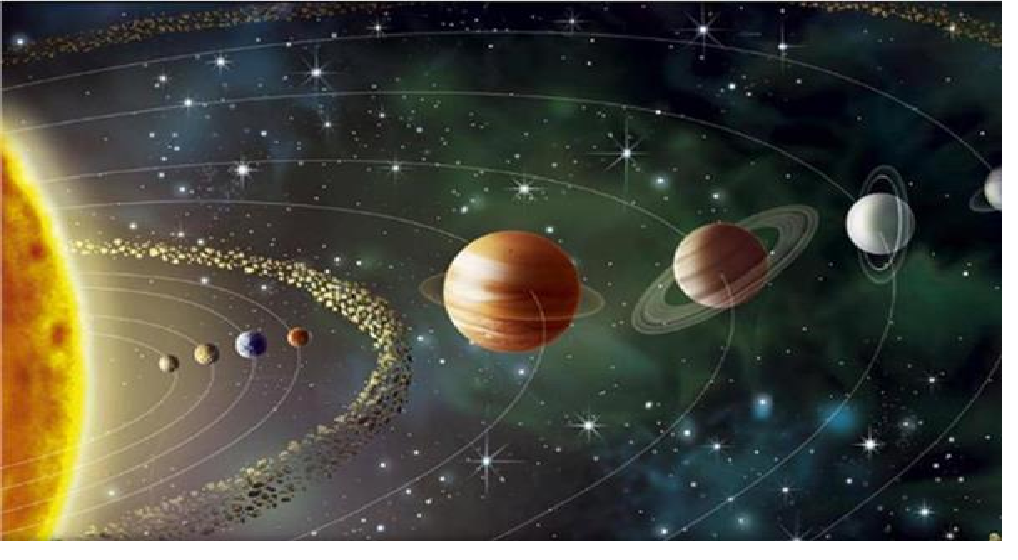
The solar system
The Solar System is a general term for a system in
which non-stellar objects, such as planets, asteroids, or comets, orbit a star.
The Sun is at the center of our Solar System, of course, and around it are the
eight known planets and many other smaller objects.
For many thousands of years, humans have recognized
the existence of a Solar System.
People believed that the Earth was stationary and
constituted the center of the universe, completely different from the moving
objects in the sky. Although the Greek philosopher
(Aristarchus of Samos) believed that the
Sun was the center of the universe. (Nicolaus
Copernicus) was the first to develop a mathematical model of the
heliocentrism of the Solar System.
In the 17th century, Galileo Galilei, Isaac Newton,
and Johannes Kepler followed in developing physical concepts that led to the
gradual acceptance that the Earth revolves around the Sun, and that the planets
move according to the same physical laws that move the Earth. The recent
development of telescopes and probes has enabled the discovery of geological
phenomena such as mountains and impact craters, and seasonal meteorological
phenomena such as clouds, sandstorms and ice caps on planets other than Earth,
such as: the Sun, Mercury,
Venus, Earth,
Mars, the asteroid belt,
Jupiter,
Saturn, Uranus,
Neptune and Pluto.
(Click on the planet for details)
Planet of the Solar System
Our solar system is currently the most beautiful
place in the universe.